
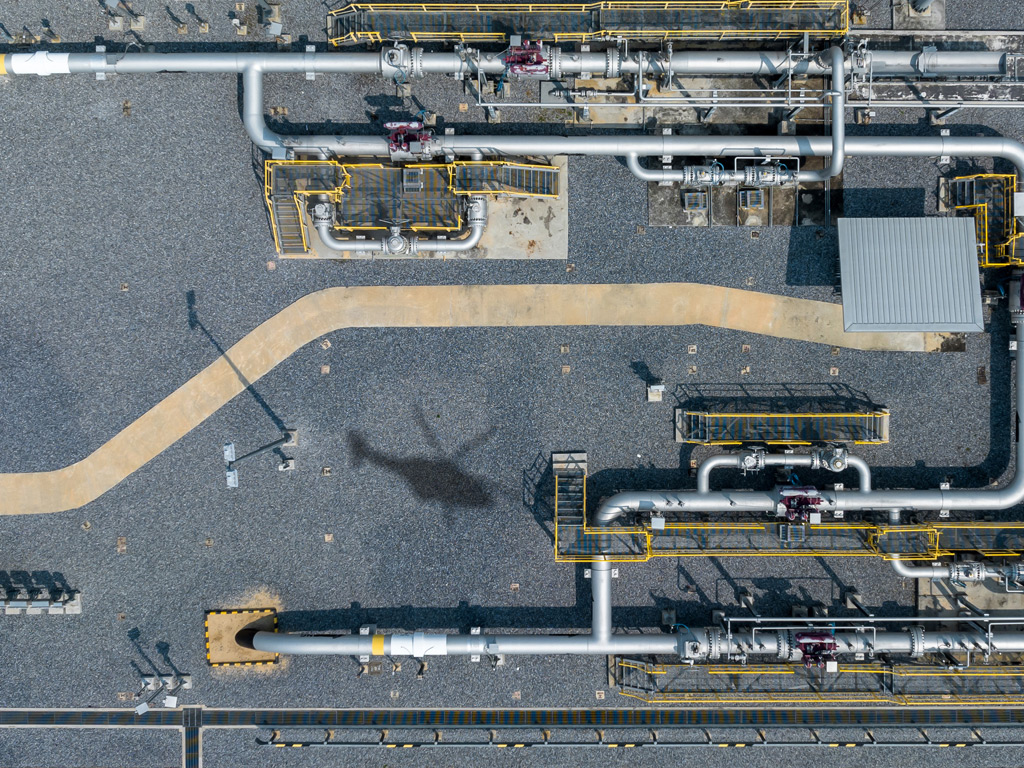
Gas pipelines are among the safest ways to transport natural gas across long distances, but no infrastructure is completely immune to failure. When a leak occurs, the consequences can range from minor methane emissions to serious safety hazards and significant environmental impact. Understanding what causes gas pipeline leaks is the first step toward preventing them and ensuring that any issues are caught early, before they escalate.
What is a gas pipeline leak and how does it happen?
A gas pipeline leak occurs when natural gas escapes from a pipeline through an unintended opening, crack, or defect in the pipe wall or its fittings. These openings can be microscopic or large enough to cause immediate danger, depending on the cause and the pressure of the gas being transported.
In high-pressure transmission pipelines, even the smallest physically possible defect in a steel pipe operating above 5 bar will generate a measurable emission. Research and certification testing have established that the minimum possible leak rate in stainless steel pipes at these pressures is approximately 150 litres per hour, equivalent to around 110 grams of methane per hour. This is not a regulatory threshold but a physical constraint determined by material properties and pressure dynamics. Below this rate, a real leak simply cannot exist in a pressurised steel transmission pipeline.
Leaks can be continuous or intermittent, and the gas that escapes does not always surface directly above the defect. Underground, methane travels through the soil before reaching the surface, and the plume widens as it moves. This behaviour means that detecting a leak from above requires scanning a broad area on either side of the pipeline, not just the pipeline route itself.
What are the most common causes of gas pipeline leaks?
Gas pipeline leaks rarely happen without a reason. The most frequently identified causes fall into a handful of categories, each with its own risk profile and detection challenges:
- Corrosion of the pipe material, particularly in older steel pipelines
- Ground movement and soil conditions that stress the pipe or its joints
- Third-party damage from excavation or construction activity near the pipeline
- Material defects or manufacturing faults present from the time of installation
- Joint and fitting failures at connection points, valves, or welds
- Pressure fluctuations that cause fatigue over time
Each of these causes requires a different approach to prevention and inspection. Understanding how they develop helps operators prioritise their maintenance programmes and make informed decisions about inspection frequency and technology.
How does corrosion cause gas pipelines to leak?
Corrosion is one of the oldest and most persistent threats to pipeline integrity. It occurs when the pipe material reacts chemically with its environment, gradually weakening the pipe wall until it can no longer contain the pressurised gas inside.
There are several types of corrosion relevant to gas pipelines:
- External corrosion happens when moisture, oxygen, or aggressive soil chemistry attacks the outside of the pipe. Pipelines with damaged or degraded protective coatings are particularly vulnerable.
- Internal corrosion can occur when the gas being transported contains moisture, hydrogen sulphide, or carbon dioxide, which react with the inner pipe wall.
- Galvanic corrosion develops when two dissimilar metals are in contact in the presence of an electrolyte, such as wet soil, creating an electrochemical reaction that eats away at the less noble metal.
- Stray current corrosion results from electrical currents in the ground, often from nearby rail lines or other infrastructure, accelerating metal loss at specific points on the pipe.
Older pipelines are naturally at greater risk, but even relatively new infrastructure can suffer from corrosion if the protective coating is damaged during installation or if cathodic protection systems are not properly maintained. Regular inspection is essential to catch corrosion-related degradation before it leads to a methane leak.
Can ground movement and soil conditions cause pipeline leaks?
Pipelines are buried underground and are therefore subject to the forces acting on the surrounding soil. Ground movement is a less obvious but genuinely significant cause of pipeline leaks, particularly in regions with unstable geology or where human activity has altered the ground.
Several soil-related factors can stress a pipeline to the point of failure:
- Soil settlement occurs when the ground beneath or beside a pipeline shifts downward, placing bending stress on the pipe.
- Frost heave in colder climates can push sections of pipeline upward as water in the soil freezes and expands, then allows them to drop again when it thaws.
- Landslides and slope instability can exert lateral forces strong enough to shear a pipeline or pull apart a joint.
- Seismic activity in earthquake-prone regions can cause sudden, severe ground displacement that ruptures a pipe.
- Subsidence from underground mining or natural geological processes can create voids beneath a pipeline, leaving it unsupported and vulnerable to cracking under its own weight and internal pressure.
Soil conditions also influence how a leak behaves once it occurs. Dense, clay-heavy soils tend to trap escaping gas and force it to travel further before surfacing, while sandy or gravelly soils allow gas to migrate more freely. This variability is one reason why aerial pipeline inspection services scan a wide grid around the pipeline rather than focusing narrowly on the pipe route itself.
How is third-party damage a leading cause of pipeline leaks?
Across Europe and globally, third-party damage, also known as mechanical interference, consistently ranks among the top causes of gas pipeline incidents. It occurs when someone working near a buried pipeline, typically during excavation, construction, or agricultural work, strikes or damages the pipe without realising it is there.
The consequences can be immediate and dramatic if the pipe is punctured, but damage can also be more subtle. A mechanical strike that does not immediately breach the pipe may still dent it, crack its protective coating, or weaken a weld, creating a defect that develops into a leak weeks or months later.
Common scenarios include:
- Excavators and diggers used in road construction or utility work striking a pipeline that was not accurately marked on local records
- Agricultural machinery, particularly deep ploughing equipment, reaching buried shallow pipelines
- Anchor drops or dredging in areas where submarine or near-shore pipelines run
- Private construction projects where homeowners or contractors fail to check for buried infrastructure before digging
Pipeline operators work to reduce this risk through awareness campaigns, accurate mapping, and physical markers along the pipeline route. However, the sheer scale of gas network infrastructure means that not every section can be continuously monitored, making periodic aerial inspection a practical and effective tool for identifying damage that may have gone unnoticed.
How are gas pipeline leaks detected before they become dangerous?
Early detection is the most effective way to prevent a gas pipeline leak from becoming a safety or environmental emergency. Several approaches are used in combination across the industry:
- Ground-based walking surveys using hand-held instruments detect methane concentrations above the atmospheric background level of approximately 2 parts per million. These are thorough but slow and resource-intensive over long pipeline networks.
- Pressure monitoring within the pipeline system can indicate a loss of containment, though it is often not sensitive enough to detect small leaks in large-diameter transmission pipelines.
- Satellite-based detection can identify large emission events over wide areas but currently lacks the spatial resolution needed to pinpoint small leaks reliably.
- Airborne laser detection combines speed and sensitivity, allowing helicopters to survey hundreds of kilometres of pipeline in a single flight while measuring methane concentrations across a wide grid on both sides of the pipeline route.
The EU Methane Regulation, which came into force in 2024, has formalised inspection requirements for pipeline operators. Under the regulation, operators must implement Leak Detection and Repair (LDAR) programmes covering underground pipelines and above-ground infrastructure. The first Type-2 LDAR survey was required by August 2025, and the technology chosen for inspection directly determines how frequently surveys must be repeated. More sensitive detection technology qualifies for longer inspection intervals, making the choice of inspection method a significant operational and commercial decision.
For underground pipelines, reliable detection requires a measurement grid covering at least 10 metres either side of the pipeline centreline, with spatial resolution better than 2 metres per measurement point. Studies by the Methane Emissions Technology Evaluation Center (METEC) and the Engler-Bunte Institute confirm that underground gas plumes widen before reaching the surface and do not always emerge directly above the leak. Any inspection approach that only measures along the pipeline line itself will miss real leaks.
How ADLARES helps detect gas pipeline leaks
At ADLARES, we provide Europe’s most advanced airborne gas leak detection service, purpose-built to find methane leaks in gas pipelines quickly, reliably, and in full compliance with regulatory requirements.
Our CHARM® technology is the world’s only DVGW-certified aerial gas remote detection system, and we have used it to inspect over 250,000 kilometres of gas pipelines across Europe since 2008. Here is what sets our service apart:
- Unmatched sensitivity: CHARM® reliably detects emissions forming 300 ppm in a 2×2 metre area just above the surface, three times more sensitive than the EU Methane Regulation’s Type-2 threshold of 1,000 ppm. This headroom ensures reliable detection under all allowable wind and altitude conditions, not just ideal laboratory settings.
- Full-grid coverage: Our helicopter surveys scan a wide measurement grid on both sides of the pipeline, meeting the spatial requirements established by METEC and the Engler-Bunte Institute’s research for reliable underground leak detection.
- Type-2 compliance: CHARM® is certified as Type-2 compliant under EU Methane Regulation 2024/1787, meaning operators who use our service can inspect underground pipelines once every three years rather than more frequently.
- Fast reporting: Critical findings are forwarded to clients within 12 hours of landing. Standard gas reports, including GPS coordinates, aerial photos with measurement overlays, and wind condition data, are delivered within 10 working days.
- Full-service quality assurance: Every kilometre of inspected pipeline is verified against DVGW G501 operational criteria by our experienced operations team. Sections that do not meet quality standards are re-flown. Non-relevant findings from nearby biogas facilities or wastewater plants are filtered out so you receive only actionable pipeline leak data.
- Secure digital delivery: Survey results are accessible via a secure Web GIS platform on desktop and mobile, so your team can act on findings wherever they are.
Whether you are planning your first LDAR survey under the EU Methane Regulation or looking to upgrade your existing inspection programme, we are ready to help. Visit our website to learn more about CHARM® and our pipeline inspection services, or get in touch with our team to discuss your network’s specific requirements.