
When it comes to detecting methane leaks along gas pipelines, not all sensing technologies work the same way. Some systems wait for the environment to deliver a signal; others actively interrogate the atmosphere with laser pulses. Understanding the difference between active and passive methane sensing is more than a technical exercise. It shapes how accurately leaks are found, how quickly surveys can be completed, and ultimately how well gas infrastructure is protected against emissions that harm both safety and the climate.
What is methane sensing and why does it matter for pipeline safety?
Methane sensing refers to any technology that identifies the presence of methane gas in the environment, whether from a small pipeline leak, a large industrial facility, or a diffuse source such as a landfill. For pipeline operators, reliable methane detection is a core safety and environmental obligation. Undetected leaks can accumulate to dangerous concentrations, contribute to greenhouse gas emissions, and result in regulatory penalties under frameworks like the EU Methane Regulation (EUMR).
The stakes are significant. Underground pipelines can develop leaks that migrate through soil before reaching the surface, meaning the visible emission point may not be directly above the defect. Gas plumes widen as they travel upward through different soil layers, which means detection technology must cover a broad corridor, not just a narrow line above the pipe. A sensing method that misses even a fraction of real leaks creates blind spots in a grid operator’s safety picture.
Beyond safety, the EU Methane Regulation introduces structured inspection requirements with defined detection thresholds. Type-1 inspections require equipment capable of detecting emissions at 17 g/h or 7,000 ppm, while the more demanding Type-2 inspections set the threshold at 5 g/h or 1,000 ppm. Choosing the right sensing method directly determines which regulatory class an operator can satisfy, and therefore how frequently inspections must be repeated.
What is passive methane sensing and how does it work?
Passive methane sensing technologies detect methane using energy that already exists in the environment, typically infrared radiation emitted naturally by the atmosphere or by the gas itself. Rather than generating their own light source, passive systems observe what is already there.
Optical Gas Imaging (OGI) cameras are among the most widely used passive tools. They detect the infrared absorption signature of methane against a background thermal scene, making leaks visible as a moving plume on screen. Handheld flame ionisation detectors and certain electrochemical sensors also fall broadly into the passive category, responding to ambient methane concentrations as an operator moves along a pipeline route.
Passive systems have genuine strengths. OGI cameras are portable, require no complex laser infrastructure, and provide an intuitive visual output that makes leaks immediately recognisable to a trained operator. However, their performance depends heavily on background conditions. Temperature contrast between the gas and its surroundings affects image quality, and detection sensitivity can vary with wind, lighting, and the thermal characteristics of the environment. At altitude, where background conditions are harder to control and the distance to the source is much greater, passive approaches face significant physical limitations.
What is active methane sensing and how does it work?
Active methane sensing systems generate their own energy source, typically a laser, and measure how that energy is absorbed or reflected by the atmosphere below. This approach does not depend on ambient conditions to provide a signal; instead, it creates a controlled interrogation of the air column between the sensor and the ground.
The most advanced form of active methane sensing used in pipeline inspection is Differential Absorption LIDAR, commonly known as DIAL. A DIAL system emits two laser pulses at slightly different wavelengths. One wavelength is strongly absorbed by methane; the other is not. By comparing the return signals from both pulses, the system calculates the concentration of methane in the measurement path with high precision. Because the system generates its own reference signal, it is far less susceptible to variations in background radiation, atmospheric lighting, or surface temperature.
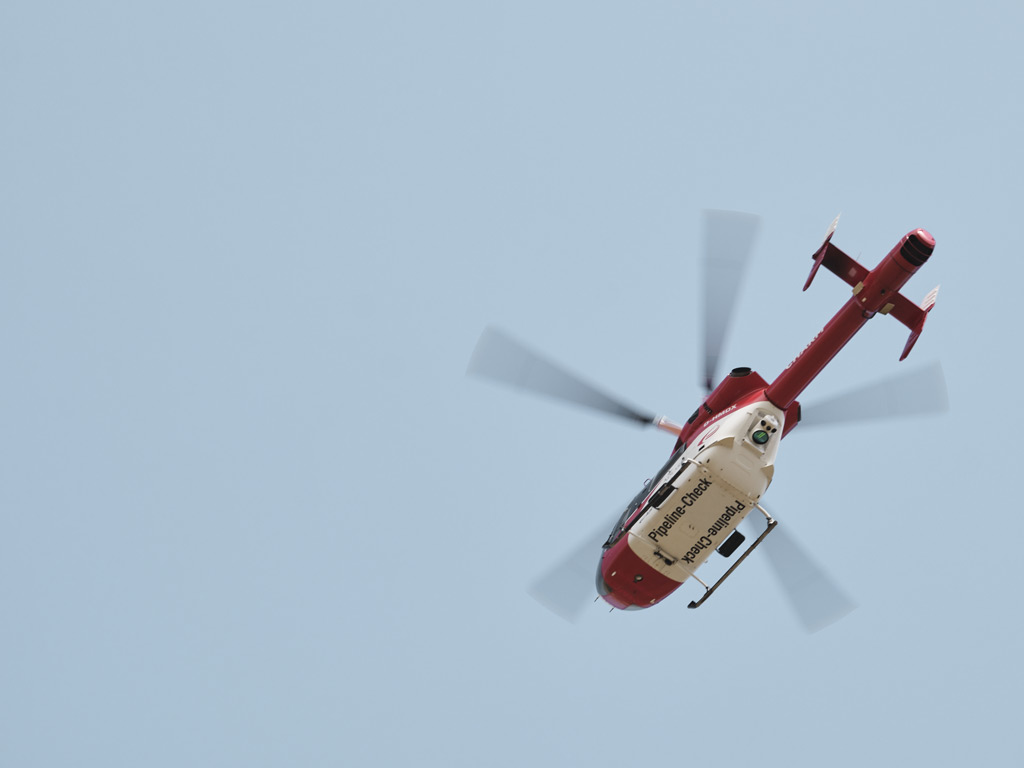
Active LIDAR methane detection systems can operate from helicopters flying at 100 to 150 metres altitude, scanning a wide corridor beneath the flight path at rates of up to 1,000 measurement points per second. This combination of speed, altitude, and measurement density makes active sensing genuinely suited to airborne methane monitoring across large pipeline networks.
What is the difference between active and passive methane sensing?
The fundamental difference lies in the energy source. Passive systems observe naturally occurring radiation; active systems generate and direct their own. This distinction has practical consequences across several dimensions:
- Independence from ambient conditions: Active DIAL systems emit their own laser pulses, so performance does not degrade with changes in sunlight, cloud cover, or surface temperature. Passive systems can be affected by all of these variables.
- Detection sensitivity: Active LIDAR methane detection can achieve per-point detection limits below 1 ppm·m, with surface sensitivity independently verified at concentrations as low as 300 ppm in a 2 by 2 metre area. Passive OGI cameras are generally suited to higher concentration events and are classified as Type-1 equipment under the EU Methane Regulation, meaning they meet the 17 g/h threshold but not the more demanding 5 g/h Type-2 requirement.
- Survey speed and coverage: Active airborne systems can survey at speeds of up to 165 km/h while maintaining a scan swath of 10 to 30 metres on either side of the pipeline centreline. Passive on-foot or vehicle-based surveys cover ground far more slowly, making them less practical for large rural transmission networks.
- Measurement metric: Active DIAL systems measure column-integrated methane concentration across the full air path, expressed in ppm·m. Passive sensors typically measure local ambient concentration in ppm at the point of the instrument. These are fundamentally different quantities, and comparing them directly can be misleading.
- Operational role: Active aerial sensing functions as a high-efficiency screening tool that flags anomaly zones across an entire network. Passive and handheld tools are better suited to close-range source confirmation after ground access has been opened.
Research from METEC and the Engler-Bunte Institute confirms that underground gas plumes widen before reaching the surface and may not emerge directly above the leak. Reliable detection therefore requires a grid of measurement points covering at least 10 metres on either side of the pipeline centreline, with spatial resolution better than 2 metres. Active airborne systems are designed to deliver exactly this kind of spatial coverage, while passive handheld tools, used along the pipeline trace alone, cannot guarantee the same breadth of coverage.
Which methane sensing method is better for aerial pipeline inspection?
For aerial pipeline inspection, active methane sensing using DIAL technology is the appropriate choice. The physical realities of operating at altitude make passive sensing impractical for reliable leak detection from a helicopter or fixed-wing aircraft.
At 100 to 150 metres altitude, the distance between the sensor and any ground-level methane plume is substantial. Passive sensors at that range would struggle to resolve the relatively low concentrations produced by the smallest physically meaningful leaks. Studies conducted as part of DVGW certification testing found that the smallest realistic leak in high-pressure stainless steel pipelines generates approximately 300 ppm at ground level directly above the pipeline route. Detecting that concentration reliably from altitude requires a system with per-point sensitivity well below that threshold, achieved through active laser interrogation rather than passive observation.
Active DIAL systems also provide the spatial coverage that underground plume physics demands. A scan swath covering the full corridor around the pipeline, combined with a sampling rate of 1,000 measurements per second, ensures that no section of the ground surface goes unsampled. Passive systems used from altitude cannot replicate this combination of sensitivity and spatial density.
It is worth noting that the two approaches are complementary rather than competing. Gas leak detection works most effectively as a two-step process: active aerial screening identifies zones that warrant further investigation, and ground teams then use passive or contact-based tools at close range to confirm the source and measure the emission rate before a repair decision is made.
How can gas grid operators use methane sensing data effectively?
Collecting methane sensing data is only the first step. The value of any inspection programme depends on how that data is processed, delivered, and acted upon.
For aerial surveys, georeferenced results are essential. Every methane indication must be tagged with precise GPS coordinates so that ground teams can locate the anomaly zone without ambiguity. Spatial accuracy of better than 2 metres is the standard needed to direct excavation or bar-hole drilling efficiently. Results delivered without precise location data create unnecessary follow-up work and increase the cost of ground investigations.
Operators benefit most when survey results are accessible through a platform that allows both desktop review and field use on mobile devices. Being able to view anomaly locations on a map, filter by severity, and assign follow-up tasks directly from the inspection report shortens the time between detection and repair. Under the EU Methane Regulation, repair obligations are triggered at the source confirmation stage, once a 1,000 ppm or 5 g/h threshold is met at the opened source. Having well-organised, accessible data makes it easier to prioritise which anomaly zones to investigate first.
Operators should also consider the regulatory implications of their chosen sensing method. Investing in Type-2 certified technology brings a direct operational benefit: underground pipelines inspected with Type-2 equipment qualify for a three-year inspection interval rather than more frequent checks. This extended interval can offset the higher cost of more sensitive technology over time, making the economics of better sensing genuinely favourable.
How ADLARES helps with airborne methane sensing for pipeline inspection
We at ADLARES have spent over two decades developing and operating the CHARM technology, an active DIAL-based airborne methane detection system built specifically for large-scale pipeline inspection. Here is what working with us delivers in practice:
- Type-2 certified sensitivity: CHARM is the world’s only DVGW-certified aerial gas detection system and is fully compliant with EU Methane Regulation Type-2 requirements, detecting surface concentrations as low as 300 ppm in a 2 by 2 metre area.
- High survey speed and coverage: Our helicopter surveys operate at up to 180 km/h with 1,000 measurement points per second and a scan swath of 10 to 30 metres, making it practical to inspect large rural transmission networks efficiently.
- Precise georeferencing: Pipeline tracking keeps the scanning centreline within 0.5 metres of the pipeline, and all findings are localised to better than 2 metres, giving ground teams the accuracy they need for targeted follow-up.
- Accessible results platform: Survey findings are delivered through a secure Web GIS platform, viewable on both desktop and mobile, so operators can review anomaly zones and coordinate repairs without delay.
- Over 250,000 km of experience: We have inspected gas pipelines for grid operators across Europe, giving us the operational depth to handle complex network geometries and varied terrain.
If you are planning your next pipeline inspection programme or want to understand how active airborne methane sensing can fit into your LDAR strategy, contact the ADLARES team to discuss your network and inspection requirements.
Dieser Inhalt wurde mithilfe von KI erstellt und kann Fehler enthalten.