
Methane leak detection has come a long way, and today pipeline operators have access to two very different categories of technology: optical gas imaging (OGI) cameras and laser-based remote sensing systems. Both can detect methane, but they work on entirely different physical principles, operate at different distances, and meet different regulatory thresholds. Understanding the distinction matters more than ever in 2026, as the EU Methane Regulation tightens inspection requirements across Europe’s gas infrastructure.
What is optical gas imaging (OGI) and how does it detect methane?
Optical gas imaging cameras are infrared cameras tuned to the specific wavelengths at which methane absorbs light. When a technician points an OGI camera at a potential leak source, escaping gas appears as a visible plume in the camera’s viewfinder, similar to watching smoke drift from a chimney. The technique is intuitive, portable, and widely used for above-ground equipment inspections at facilities, valve stations, and compressor sites.
The key characteristic of OGI is that it is a close-range, line-of-sight technology. The operator must be near the suspected leak source, typically within a few metres, to visualise the gas cloud effectively. This makes OGI well suited for detailed inspections of above-ground components but less practical for surveying long stretches of buried pipeline across rural terrain.
Under the EU Methane Regulation, OGI cameras are classified as suitable for Type-1 inspections, which require a detection threshold of a 17 g/h emission rate or a local concentration of 7,000 ppm. That is a meaningful sensitivity level for close-range work, but it is not sufficient to meet the more demanding Type-2 standard.
What is laser methane detection and how does it work?
Laser methane detection uses the same fundamental physical principle as OGI, namely that methane molecules absorb light at specific wavelengths, but it applies that principle at a distance and with far greater precision. The most advanced form of airborne laser detection uses Differential Absorption LIDAR (DIAL), which emits two laser pulses at slightly different wavelengths. By comparing how much each pulse is absorbed along its path through the atmosphere, the system can calculate the concentration of methane with very high accuracy.
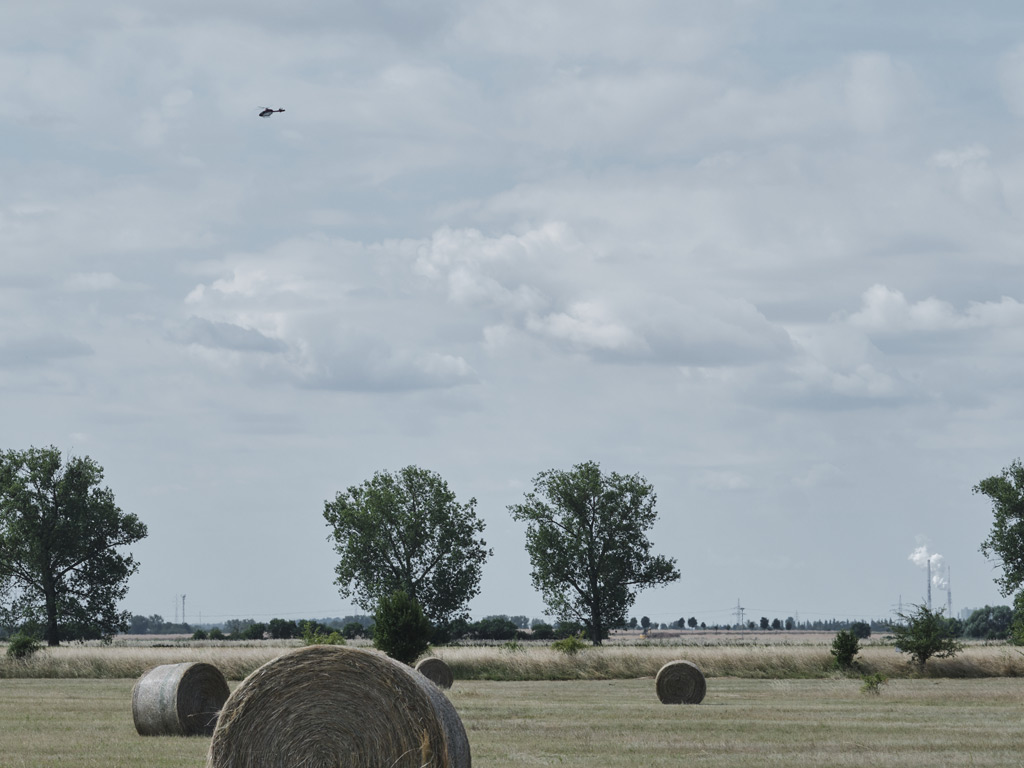
DIAL systems designed for pipeline inspection operate from helicopters flying at altitudes of 100 to 180 metres and speeds of up to 165 km/h. Rather than producing a single line of measurement points beneath the aircraft, a scanning imaging LIDAR captures an entire strip 24 to 25 metres wide along the pipeline corridor, generating a dense grid of data points at a rate of 1,000 measurements per second. This spatial coverage is critical, because underground gas leaks do not always surface directly above the pipe. Depending on soil structure, a methane plume can migrate laterally before reaching the surface, meaning a system that only measures directly above the pipeline centreline can miss real leaks entirely.
Research by METEC and the Engler-Bunte Institute confirms that reliable detection of underground leaks requires a measurement grid extending at least 10 metres either side of the pipeline, with spatial resolution better than 2 metres per measurement point. Laser DIAL systems designed for airborne pipeline inspection are built around exactly these requirements.
What are the main differences between OGI cameras and laser methane detection?
The differences between the two technologies span operating distance, survey speed, spatial coverage, and regulatory classification. Here is a direct comparison of the key attributes:
- Operating distance: OGI cameras work at close range, typically a few metres from the source. Laser DIAL systems operate from 100 to 180 metres altitude.
- Survey speed: OGI requires a technician to walk or drive slowly along the route. Airborne laser inspection covers pipeline corridors at up to 165 km/h.
- Coverage pattern: OGI produces a point-by-point inspection along above-ground equipment. Laser DIAL scans a wide strip, covering the full area where an underground plume might surface.
- Detection threshold: OGI meets the Type-1 standard of 17 g/h or 7,000 ppm. Advanced laser DIAL systems can be certified to meet the Type-2 standard of 5 g/h or 1,000 ppm.
- Best application: OGI excels at facility-level inspections of above-ground components. Laser DIAL is optimised for long-distance pipeline corridor surveys and rural transmission networks.
It is worth emphasising that these technologies are complementary rather than competing. A two-step LDAR methodology, as defined by the EU Methane Regulation, uses aerial laser screening in Step 1 to identify anomaly zones across large areas, then deploys ground teams with close-range instruments in Step 2 to confirm the source and trigger the repair obligation. OGI cameras and handheld devices are natural tools for that ground-level confirmation work.
Which method is more sensitive for detecting small methane leaks?
For detecting small leaks from underground pipelines at a distance, advanced laser DIAL systems are significantly more sensitive than OGI cameras. The physical reason is straightforward: a laser beam integrates methane concentration along its entire path through the atmosphere, which amplifies the signal from even a diffuse plume near the ground. OGI cameras, by contrast, need a visible concentration of gas in front of the lens to produce a usable image.
The practical sensitivity gap is substantial. OGI is rated for Type-1 detection at 7,000 ppm local concentration. Certified airborne DIAL systems can reliably detect surface concentrations of 300 ppm across a 2 by 2 metre area, which is more than twenty times more sensitive. This matters because underground leaks in high-pressure stainless steel pipelines, even at the smallest physically possible leakage rates, may only generate ground-level concentrations in the range of 300 ppm. A system that cannot resolve signals at that level will miss those leaks entirely.
One clarification worth making concerns the „2 ppm“ sensitivity figure sometimes cited in tender documents. That figure refers to handheld ground probes operating at the atmospheric background concentration of methane, which is approximately 2 ppm. It describes the instrument’s sensitivity floor relative to ambient air and is not a meaningful benchmark for aerial detection systems, where the relevant signal is the ground concentration generated by a real underground leak.
When should pipeline operators use laser detection instead of OGI?
The choice of technology should follow the inspection context. Airborne laser methane detection is the practical choice when:
- The pipeline is buried underground and runs through rural or semi-rural terrain where on-foot surveys would be slow and costly.
- The operator needs to survey hundreds or thousands of kilometres efficiently within a regulatory inspection cycle.
- The regulatory requirement is Type-2 compliance under the EU Methane Regulation, which demands the 5 g/h or 1,000 ppm detection threshold.
- The goal is to screen a large corridor quickly and direct ground teams only to the locations that genuinely warrant investigation.
OGI cameras remain the right tool for above-ground facility inspections, valve stations, pressure regulation equipment, and the Step 2 source confirmation phase after aerial anomalies have been identified. Dense urban distribution networks, where above-ground infrastructure is concentrated and helicopter access is restricted, are also better served by vehicle-based or on-foot surveys with close-range instruments.
How does laser methane detection comply with EU methane regulations?
The EU Methane Regulation (2024/1787) introduces a two-class inspection framework for underground pipeline equipment. Type-1 inspections require detection at 17 g/h or 7,000 ppm and are conducted more frequently. Type-2 inspections require detection at 5 g/h or 1,000 ppm, a threshold that demands more sophisticated equipment, but in return the inspection interval for underground pipelines is extended to once every three years. This structure gives operators a direct economic incentive to invest in higher-sensitivity technology.
For an airborne system to qualify for Type-2 compliance, it must be independently certified to reliably detect the 1,000 ppm threshold, which in practice means per-point sensitivity must be at least three times better than that threshold to ensure reliability under all operating conditions. Certification against a recognised technical standard, such as DVGW G465-4-5 (formerly G501), provides the documented, reproducible evidence that regulators require. The DVGW standard has required safe identification of leaks at 150 g/h under realistic operating conditions since 2012, a benchmark that already exceeds what some industry bodies have proposed as an acceptable aerial detection limit in 2026.
Survey results from certified airborne inspection campaigns are delivered via secure Web GIS platforms, providing GPS-tagged anomaly reports that ground teams can act on directly. This digital reporting chain is an important part of meeting the EU Methane Regulation’s Article 14(14) documentation and reporting obligations.
How ADLARES helps with methane leak detection from pipelines
We at ADLARES have been providing certified airborne methane detection services since 2008, and our CHARM technology is the world’s only DVGW-approved aerial gas remote detection system. To date, we have inspected more than 250,000 km of gas pipelines for grid operators across Europe. Here is what we bring to every inspection programme:
- Type-2 certified sensitivity: CHARM is independently certified by the DVGW Research Centre to detect surface concentrations of 300 ppm across a 2 by 2 metre area, meeting and exceeding the EU Methane Regulation Type-2 threshold.
- Wide-swath scanning: Our system scans a 24 to 25 metre wide corridor at 1,000 measurements per second, covering the full area where underground plumes can surface, not just the pipeline centreline.
- High survey speed: Helicopter-based inspection at up to 165 km/h means we can cover large network sections efficiently, reducing the total cost of compliance compared to on-foot surveys across the same route length.
- GPS-tagged anomaly reports: Results are delivered via a secure Web GIS platform, accessible on desktop and mobile, so your ground teams can move directly to Step 2 source confirmation in prioritised zones.
- Regulatory documentation: Our certified methodology and reporting outputs are designed to support your EU Methane Regulation compliance records.
If you are planning your next inspection cycle or evaluating whether your current approach meets the Type-2 standard, we would be glad to discuss your network and how our services can help. Get in touch with our team to start the conversation.
Dieser Inhalt wurde mithilfe von KI erstellt und kann Fehler enthalten.