
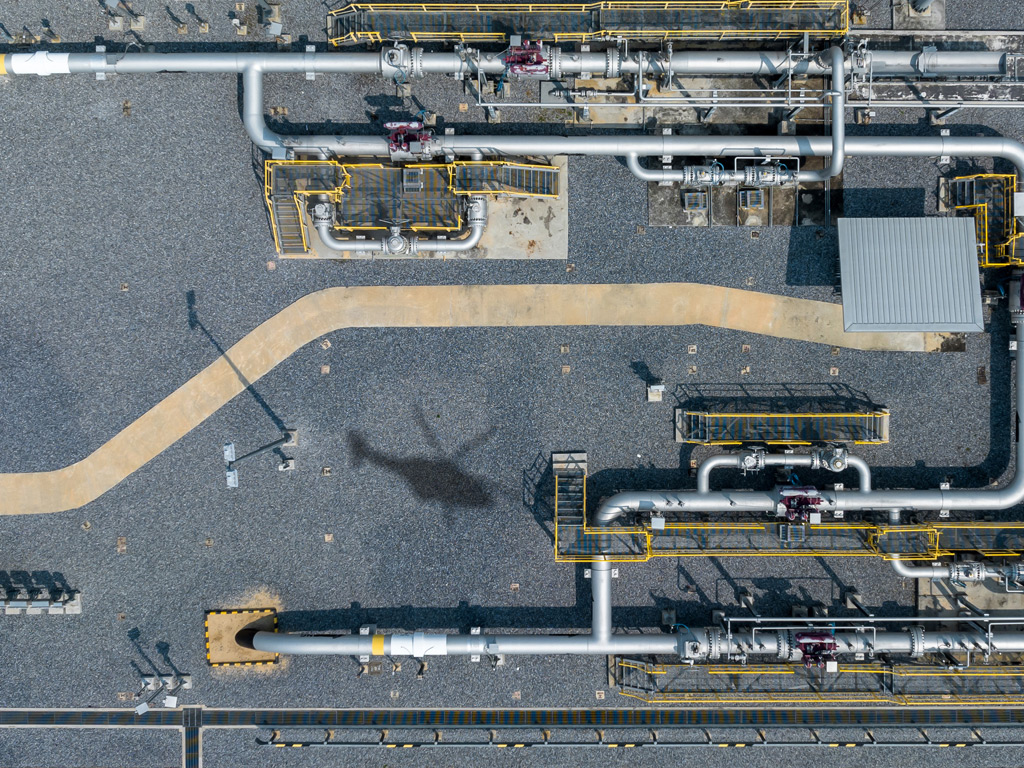
The main difference between OGI and sniffing in LDAR surveys is how they detect methane leaks: optical gas imaging (OGI) uses an infrared camera to visualize gas plumes remotely without physical contact, while the sniffing method uses a handheld or vehicle-mounted probe placed close to or directly on a surface to measure gas concentration. OGI covers larger areas faster and works well for above-ground equipment, whereas sniffing offers precise, localized readings at specific points. Understanding both methods helps gas network operators choose the right approach for their specific inspection obligations.
How does optical gas imaging actually detect methane leaks?
Optical gas imaging detects methane leaks by using a specialized infrared camera sensitive to the wavelengths at which methane absorbs light. When gas escapes from a fitting, valve, or joint, the camera renders the invisible plume as a visible, smoke-like cloud on screen, allowing an inspector to identify the leak source in real time without touching the equipment. OGI is a passive, remote sensing technique that works at distances of several meters to tens of meters.
The core principle relies on the fact that methane absorbs infrared radiation at specific wavelengths. The OGI camera filters incoming light to a narrow band where methane absorption is strongest, making escaping gas appear as a dark or contrasting visual against the background. Trained operators can assess the size and movement of the plume to estimate relative leak severity, though OGI does not inherently provide a quantified leak rate without supplementary measurement.
OGI is particularly effective for above-ground components: compressor stations, metering points, pressure regulation equipment, and exposed fittings. It excels in situations where a technician needs to scan a large number of components quickly without interrupting operations. Because the inspector does not need physical access to every individual component, OGI surveys can be conducted efficiently across complex installations.
How does the sniffing method work in pipeline surveys?
The sniffing method works by drawing air samples through a sensor probe that is held close to, or in direct contact with, a potential leak point. The instrument measures the concentration of methane in the sample and triggers an alert when readings exceed a set threshold. Sniffing is a contact-based or near-contact technique that requires the inspector to move the probe along the pipeline route or around each component systematically.
In pipeline surveys, sniffing is commonly performed by walking inspectors who carry a portable flame ionization detector (FID) or catalytic combustion sensor along the pipeline right-of-way, or by vehicles equipped with high-sensitivity analyzers that draw in roadside air as they drive above buried pipelines. For underground distribution networks, vehicle-mounted sniffers are a widely used approach because the gas migrating through the soil can be detected at the surface above the pipe.
The strength of sniffing lies in its ability to detect very low concentrations and to pinpoint leak locations with spatial precision. However, the method is inherently sequential: the inspector or vehicle must physically traverse every metre of the route, which makes it time-consuming for long-distance transmission pipelines. Detection reliability is also sensitive to wind conditions, soil type, and pipe depth, all of which influence how gas migrates to the surface.
What are the key differences between OGI and sniffing for LDAR?
The key differences between OGI and sniffing for LDAR surveys are the detection mechanism, coverage speed, leak quantification capability, and suitability for different infrastructure types. OGI is remote, visual, and fast across above-ground equipment; sniffing is contact-based, concentration-measuring, and better suited to locating leaks in buried or enclosed infrastructure. Neither method is universally superior — each addresses a different inspection scenario.
Coverage speed and survey scale
OGI allows a single inspector to scan many components in a short time because the camera covers a wide field of view from a distance. Sniffing requires physical proximity to each potential leak point, making it significantly slower per unit of pipeline length. For transmission networks spanning hundreds or thousands of kilometres, this speed difference has a direct impact on survey cost and scheduling.
Leak quantification and sensitivity
Standard OGI cameras detect leaks visually but do not automatically provide a quantified emission rate. Some advanced OGI systems can estimate flow rates, but this requires additional processing. Sniffing instruments measure concentration directly, which gives a numerical reading, though converting concentration to a volumetric leak rate still requires further calculation. Both methods have minimum detection thresholds that depend on equipment quality, environmental conditions, and operator technique.
Which LDAR method meets EU Methane Regulation requirements?
Under EU Regulation 2024/1787, both OGI and sniffing can satisfy LDAR survey requirements depending on the infrastructure type and the specific provisions that apply. The regulation defines survey categories and sets minimum performance thresholds, meaning operators must use methods capable of detecting leaks at the sensitivity levels specified for each equipment category. Neither method is mandated exclusively, but the chosen technique must meet the regulation’s detection sensitivity criteria.
The regulation introduced significantly shorter inspection intervals for transmission and distribution infrastructure, which increases the total survey workload for operators. This is where the speed of the chosen method becomes critical: a technique that is thorough but slow may not allow operators to complete all required surveys within the new timeframes without substantially increasing resources.
For large-scale transmission pipelines, airborne leak detection services have emerged as a practical complement to ground-based methods precisely because they can cover long distances rapidly while meeting the high-sensitivity requirements for Type 2 underground equipment under the regulation. Ground-based OGI and sniffing remain the standard for above-ground components and shorter distribution segments.
When should operators use OGI, sniffing, or aerial detection?
Operators should use OGI for above-ground equipment inspections where visual identification of leaking components is the priority, sniffing for buried distribution pipelines where gas migration to the surface needs to be detected, and aerial detection for long-distance transmission pipelines where survey speed and scale are the defining constraints. The right choice depends on infrastructure type, pipeline length, inspection interval requirements, and the sensitivity threshold mandated by regulation.
A practical framework for selecting the appropriate method looks like this:
- OGI: Best for compressor stations, above-ground valves, pressure regulation equipment, and any facility where a large number of components need to be surveyed quickly without contact
- Sniffing: Best for urban and suburban distribution networks, buried pipelines in accessible rights-of-way, and situations where precise leak location and concentration measurement are needed
- Aerial detection: Best for high-pressure transmission pipelines, remote or difficult-to-access routes, and networks where the total inspection distance makes ground-based surveys impractical within required intervals
In practice, many operators combine methods. A transmission system operator might use aerial surveys to screen the entire network rapidly, then deploy ground-based sniffing or OGI teams to investigate and confirm specific indications flagged from the air. This layered approach balances coverage speed with the localization precision needed for repair prioritization.
The choice is also influenced by regulatory context. As inspection intervals under the EU Methane Regulation tighten, operators managing extensive networks need to reconsider whether their current ground-based survey capacity can realistically deliver full coverage on the new schedule. In those cases, faster methods are not just convenient — they are operationally necessary.
How ADLARES supports your LDAR survey strategy
We provide a high-speed, high-sensitivity alternative to ground-based OGI and sniffing for operators who need to meet EU Methane Regulation LDAR requirements across large pipeline networks. Our CHARM® airborne gas detection technology is the world’s only DVGW-approved gas remote detection system, and it has been used to inspect over 250,000 km of gas pipelines across Europe since 2008.
Here is what working with us delivers:
- Survey speed: Helicopter-based surveys at up to 180 km/h, enabling large networks to be covered within tight regulatory timeframes
- High sensitivity: Detection of leakage rates from 150 l/h, meeting EU Methane Regulation Type 2 sensitivity requirements for underground equipment
- Regulatory compliance: CHARM® is specifically designed to support compliance with EU Regulation 2024/1787 LDAR obligations for transmission and distribution operators
- Actionable results: Survey findings are delivered via a secure Web GIS platform, accessible on desktop and mobile, so your teams can verify and prioritize repairs immediately
- Proven track record: Over two decades of commercial operation and partnerships with major European gas grid operators
Whether you are planning your first aerial LDAR survey or looking to integrate airborne detection into an existing inspection programme alongside OGI and sniffing, we are ready to help. Contact the ADLARES team to discuss your network’s specific requirements and find out how CHARM® fits into your compliance strategy.
Dieser Inhalt wurde mithilfe von KI erstellt und kann Fehler enthalten.